

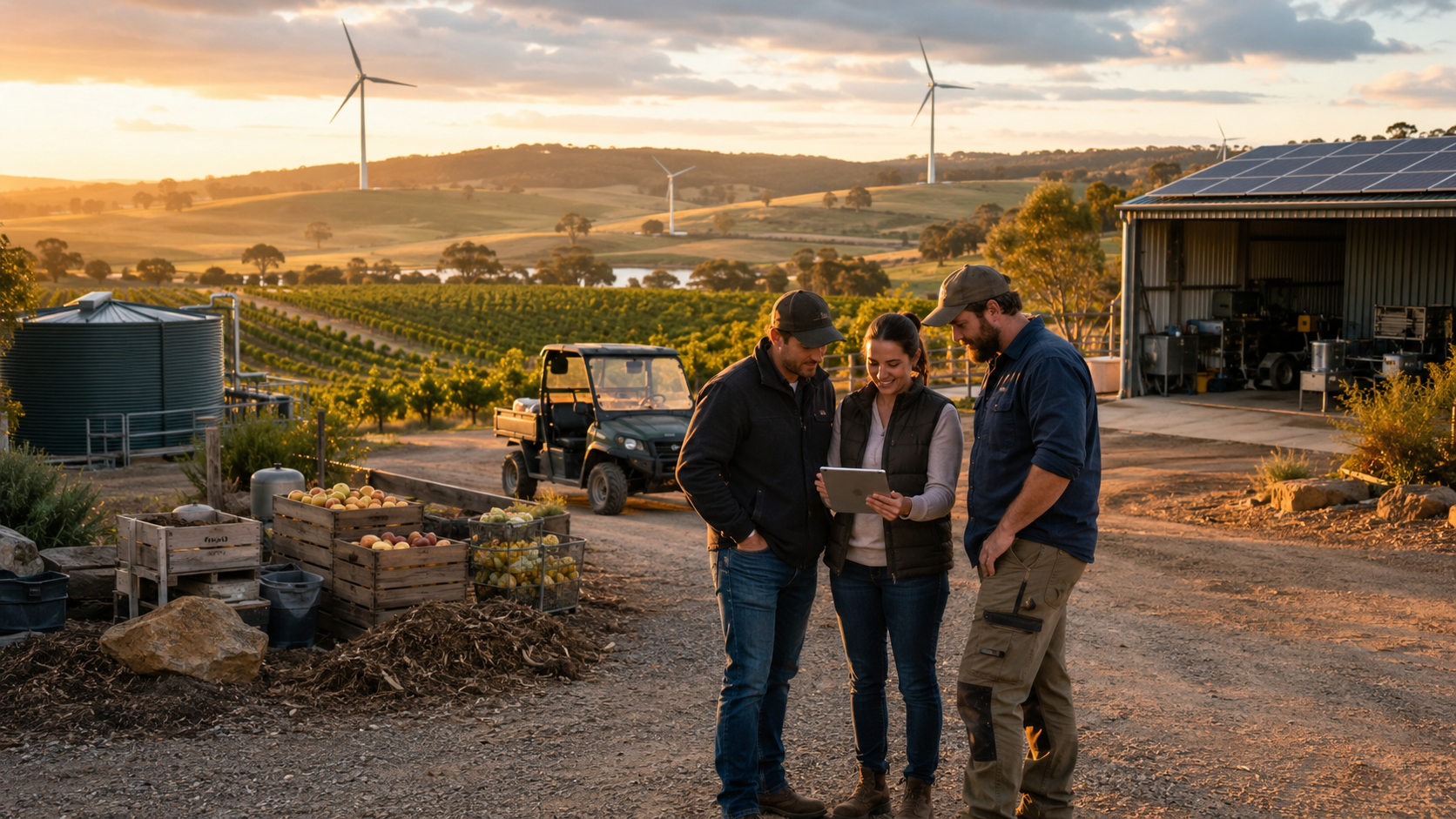
Australia’s Sustainability Economy Is Not Only an Urban Story
Discussions about entrepreneurship often focus on Sydney, Melbourne and other major innovation centres.
Yet some of Australia’s most practical sustainable business opportunities are emerging in regional communities.
The reasons are straightforward.
Regional businesses operate close to the systems that sustainability seeks to transform: energy generation, agriculture, food production, land management, water use, transport and natural resources.
In 2026, entrepreneurs are increasingly examining how these local assets can support new businesses while strengthening community resilience.
The result is a distinctive form of sustainable entrepreneurship. It is often less focused on consumer branding and more focused on solving expensive operational problems.
Clean Energy Is Creating Local Business Ecosystems
The Opportunity Extends Beyond Building Renewable Projects
Large clean-energy developments can create demand for more than engineering and construction.
Regional economies may need accommodation, maintenance, transport, environmental monitoring, workforce training, professional services and technology support.
Entrepreneurs who understand local conditions can identify gaps around these projects.
At the same time, businesses are exploring how cheaper and cleaner energy systems can support new types of economic activity, from electrified industrial operations to energy-intensive processing closer to where raw materials are produced.
The Australian Renewable Energy Agency publishes information about renewable-energy projects, innovation and investment at https://arena.gov.au/.
For regional entrepreneurs, such resources can help illustrate how the energy transition is creating a much wider commercial ecosystem.
Agriculture Is Becoming a Circular-Economy Laboratory
Australian agriculture produces valuable food and fibre, but it also generates by-products.
The traditional question has been how to dispose of these materials. The entrepreneurial question is whether they still contain economic value.
Crop residues, imperfect produce and processing by-products may have potential applications in ingredients, soil products, biomaterials, animal feed or energy systems.
Not every idea will be commercially viable. Transport distances, processing costs and regulatory requirements can quickly destroy a weak business model.
That is why the most promising circular agriculture ventures tend to begin with a specific local problem.
A founder who understands the volume, consistency and location of a waste stream is in a stronger position than someone beginning with a broad ambition to “upcycle agricultural waste.”
Resilience Is Becoming a Market
Climate-related disruption is also changing the types of products and services regional businesses need.
Water efficiency, remote monitoring, energy storage, resilient communications and supply-chain planning can all create entrepreneurial opportunities.
This is an important shift in the meaning of sustainable business.
A company does not need to sell an obviously “green” consumer product to contribute to sustainability. A software platform that helps farmers detect equipment problems earlier may reduce wasted resources. A logistics business that improves local distribution may reduce vulnerability to disruption.
The impact comes from the problem being solved.
Local Knowledge Can Become a Competitive Advantage
Regional entrepreneurs often possess something that outside companies struggle to replicate: detailed knowledge of local conditions.
They understand seasonal patterns, transport limitations, workforce realities and relationships between businesses.
That knowledge can help founders design solutions that are more practical than ideas developed far from the communities expected to use them.
The challenge is scale.
A business built for one region may need to determine whether the same problem exists elsewhere. Digital technology, modular services and partnerships can help local solutions reach wider markets without losing their practical foundations.
In Australia’s 2026 sustainability economy, regional entrepreneurship deserves more attention.
The transition toward cleaner energy, more efficient resource use and stronger local resilience is creating problems that require commercial solutions. Founders who combine technical knowledge with a deep understanding of place may be positioned to build businesses that are both commercially useful and socially significant.