

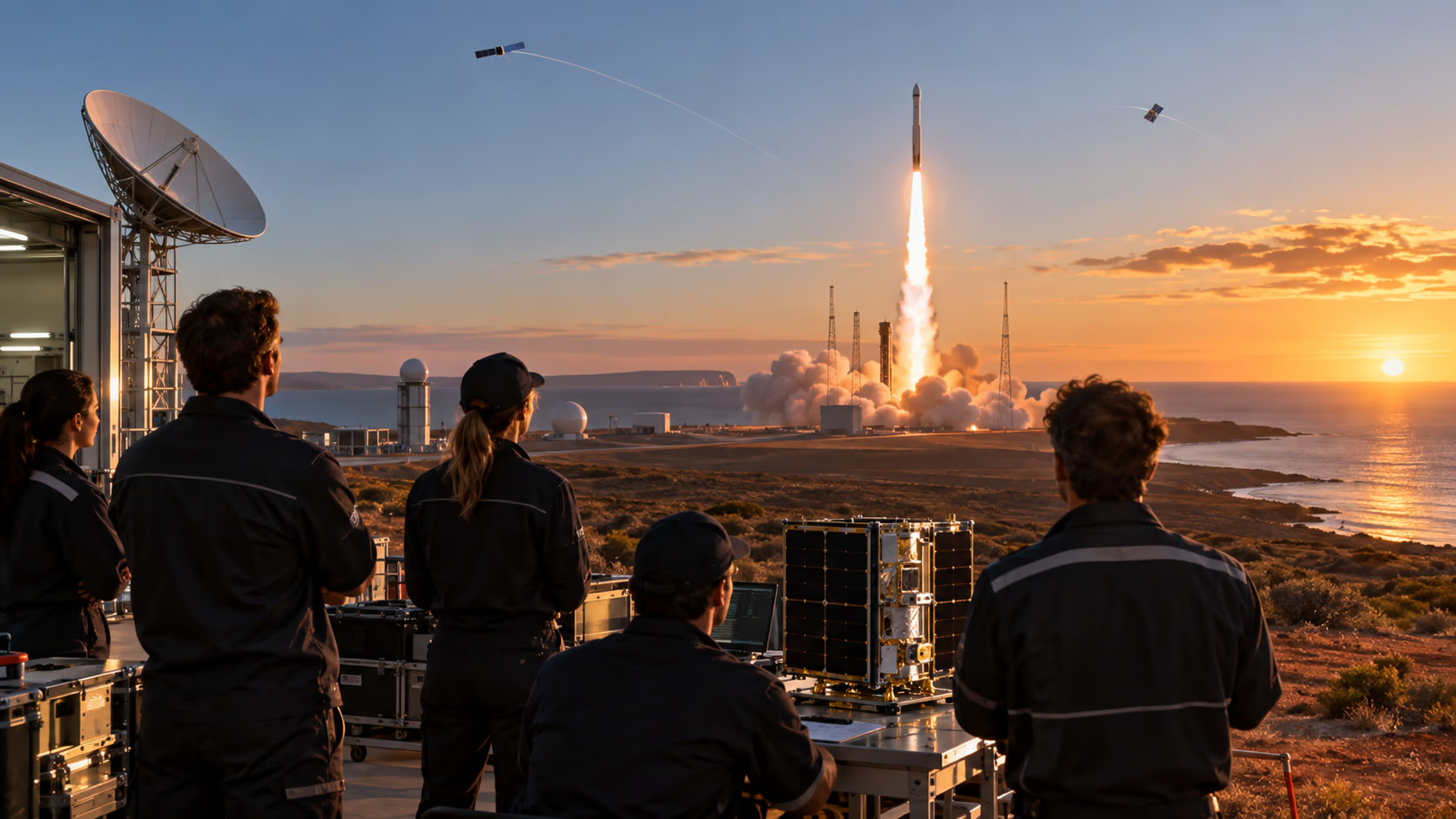
Australia’s space startup pipeline has never been stronger. Behind the headline funding rounds and launch milestones, a quieter transformation is taking place in incubators, university labs, and co-working spaces across the country. A new generation of founders is building companies that address everything from satellite propulsion and space debris tracking to microgravity research and sustainable life support. In 2026, that pipeline is beginning to deliver.
The Venture Catalyst Space program at Adelaide University’s Innovation & Collaboration Centre is a case in point. Its 2026 cohort selected eight startups, covering microgravity research, climate risk, advanced materials, and space-enabled data solutions. Since its inception in 2018, the program has supported 54 startups, helping them attract up to $135 million in investment. The cohort includes THE RED PLAN-ET, which is exploring sustainable menstrual care solutions for long-duration space missions. That might sound niche, but it reflects a broader truth: as humans spend more time in space, the need for human-centred innovation grows. Startups that solve these problems early can build defensible intellectual property and global markets.
Adelaide is not the only hub. Sydney, Melbourne, Brisbane, and Perth all host space-focused accelerators, research centres, and meetups. The Australian Space Agency’s official portal (https://www.australianspaceagency.gov.au/) tracks the sector’s growth, and its 2026 data shows a steady increase in the number of space-related startups, patents, and jobs. The agency’s efforts are complemented by state government programs, university commercialisation offices, and private investors who are increasingly comfortable with space as an asset class.
The most mature startups are attracting significant capital. Gilmour Space Technologies raised $217 million in Series E funding, including $75 million from the National Reconstruction Fund Corporation and $75 million from Hostplus. Southern Launch raised $25 million in Series A funding, with $10 million from the NRF. Myriota continues to expand its direct-to-satellite IoT network. These companies are not just success stories. They are anchors for the ecosystem. They hire engineers, buy components from local suppliers, and mentor founders. When Gilmour scales production of the Eris rocket and ElaraSat satellite bus, it creates demand for precision manufacturing, avionics, and software. When Southern Launch operates the Koonibba Test Range and Whalers Way Orbital Launch Complex, it creates opportunities for payload integrators, range safety specialists, and data analysts.
The government’s Statement on Space, released in July 2026, recognises the importance of a strong startup pipeline. It calls for an enduring space sector, with sovereign capability in launch, satellites, and data. For founders, this means access to funding, but also a clear demand signal. Defence, agriculture, mining, telecommunications, and emergency services all need space-based solutions. Startups that can demonstrate commercial traction and dual-use potential are well positioned to win government contracts.
The challenges are familiar to anyone in the startup world. Access to capital is uneven. Regulatory pathways can be complex. Hiring experienced engineers is competitive. But Australia’s space startups have advantages. They operate in a country that understands the value of space-based services. They benefit from world-class universities and research organisations. They are supported by a government that has decided to treat space as strategic infrastructure. And they are part of a global market that is growing rapidly.
In 2026, the pipeline is no longer a promise. It is a reality. From Adelaide to orbit, Australian founders are building companies that will define the next decade of space technology. The question is no longer whether Australia can produce world-class space startups. It is how many, how fast, and how far they can go.