

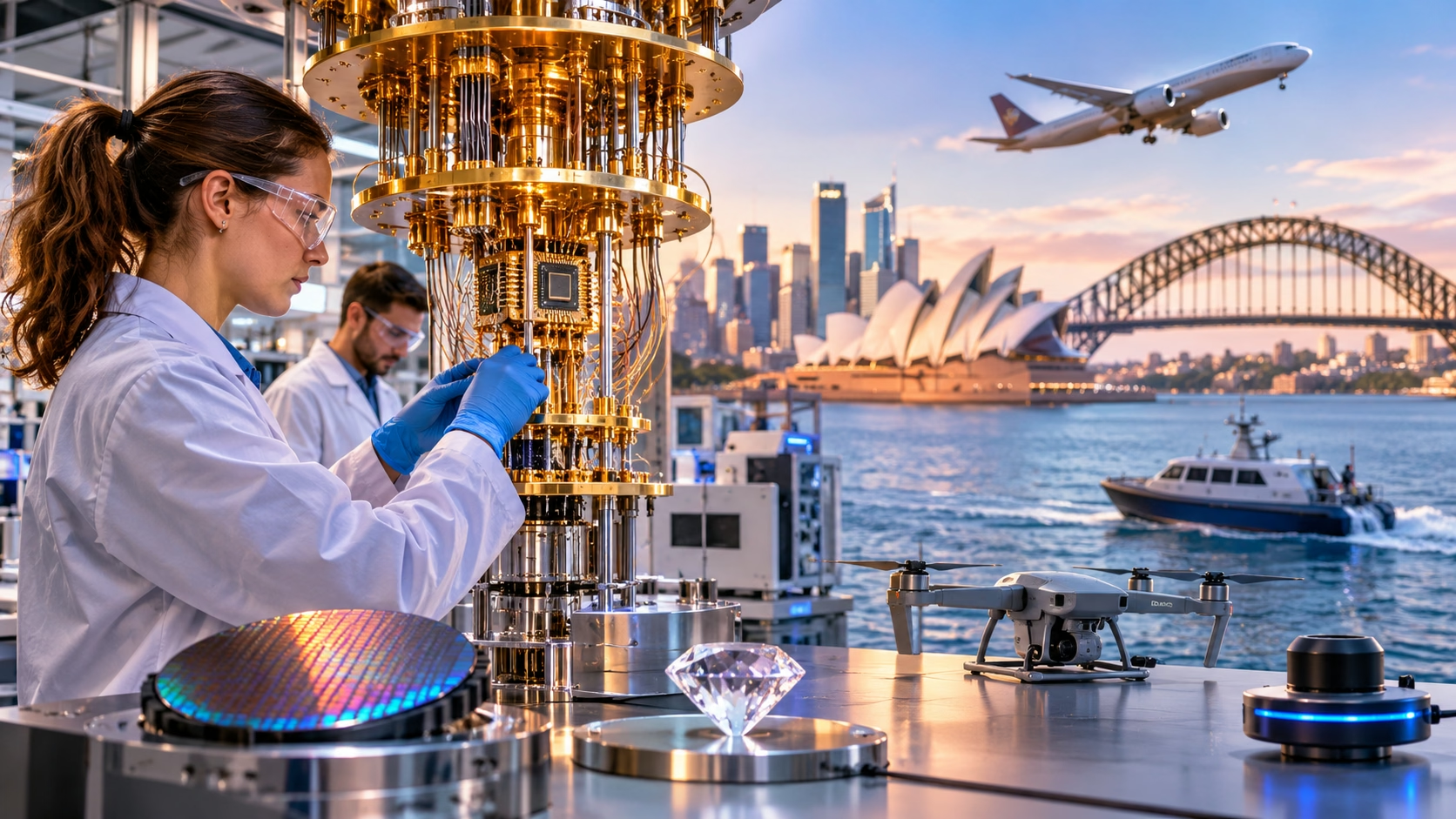
Australia Is Building a Commercial Quantum Technology Ecosystem
Australia’s quantum technology industry is evolving from a research-intensive sector into an emerging commercial market supported by startups, investors, universities and established industrial partners.
The country has developed considerable scientific expertise in quantum computing, precision measurement and semiconductor engineering.
Increasingly, companies are attempting to transform this expertise into products that solve identifiable business problems.
The transition is particularly visible in 2026, as firms pursue data-centre installations, navigation technology demonstrations and specialised manufacturing infrastructure.
However, commercial readiness varies considerably between applications. Quantum sensing is already demonstrating practical capabilities, while fault-tolerant quantum computing remains a longer-term engineering objective.
Government Investment Supports Commercial Development
Public investment continues to play an important role in Australia’s quantum technology strategy.
On October 2, 2026, the federal government announced AUD 12.3 million in funding for six commercially focused projects.
The funding forms part of the Critical Technologies Challenge Program, which supports the development and adoption of emerging technologies.
Sydney-based Silicon Quantum Computing secured AUD 3.6 million for a quantum-enhanced artificial intelligence processing initiative.
Working with Schneider Electric and the University of New South Wales, the company plans to investigate improved electricity forecasting and renewable energy integration.
According to the official October 2026 funding announcement, additional projects involve quantum clocks, biosensors and logistics optimisation.
The programme demonstrates how public funding can connect research institutions with companies investigating commercially relevant applications. minister.industry.gov.au
Silicon Quantum Computing Creates New Infrastructure Opportunities
Hardware development represents another essential element of Australia’s emerging quantum economy.
Diraq, a Sydney-based quantum computing company, is developing semiconductor processors using silicon spin qubits.
Its technology seeks to benefit from established semiconductor manufacturing methods while addressing the substantial technical challenges associated with scaling quantum processors.
In September 2026, Diraq and Equinix announced plans to integrate an eight-qubit quantum computer into a Sydney commercial data centre.
The system is designed to operate alongside conventional computing equipment with electricity consumption below 20 kilowatts.
The project could help demonstrate how future quantum systems might be incorporated into existing digital infrastructure. Equinix Newsroom
Quantum Navigation Demonstrates Industrial Relevance
Australian quantum companies are also developing applications that do not require powerful general-purpose quantum computers.
Q-CTRL is advancing quantum sensing technology for navigation in environments where GPS signals are unavailable.
In August 2026, the company reported successful maritime trials using quantum measurements of Earth’s gravitational field.
The system achieved approximately one nautical mile of positioning accuracy during the demonstration.
Such technologies could eventually serve customers in maritime transportation, aviation and defence.
Their development illustrates how companies may establish specialised commercial markets while more complex quantum computing technologies continue to mature. Q-CTRL
Manufacturing and Infrastructure Strengthen Future Growth
Australia’s quantum industry is expanding its production capabilities alongside software and hardware development.
Quantum Brilliance opened a commercial quantum diamond foundry in Melbourne in November 2025, supporting the manufacture of materials for room-temperature quantum devices.
Meanwhile, PsiQuantum commenced construction of a planned large-scale quantum computing facility at Moreton Bay in June 2026.
These investments could strengthen advanced manufacturing capabilities, attract specialised talent and support future international partnerships.
Nevertheless, commercial success will require more than technological demonstrations.
Startups must establish dependable manufacturing processes, competitive operating costs and customers willing to pay for measurable advantages.
Australia’s future position in the global quantum market will depend on how effectively its research institutions, companies and industrial partners transform emerging capabilities into scalable commercial products.