

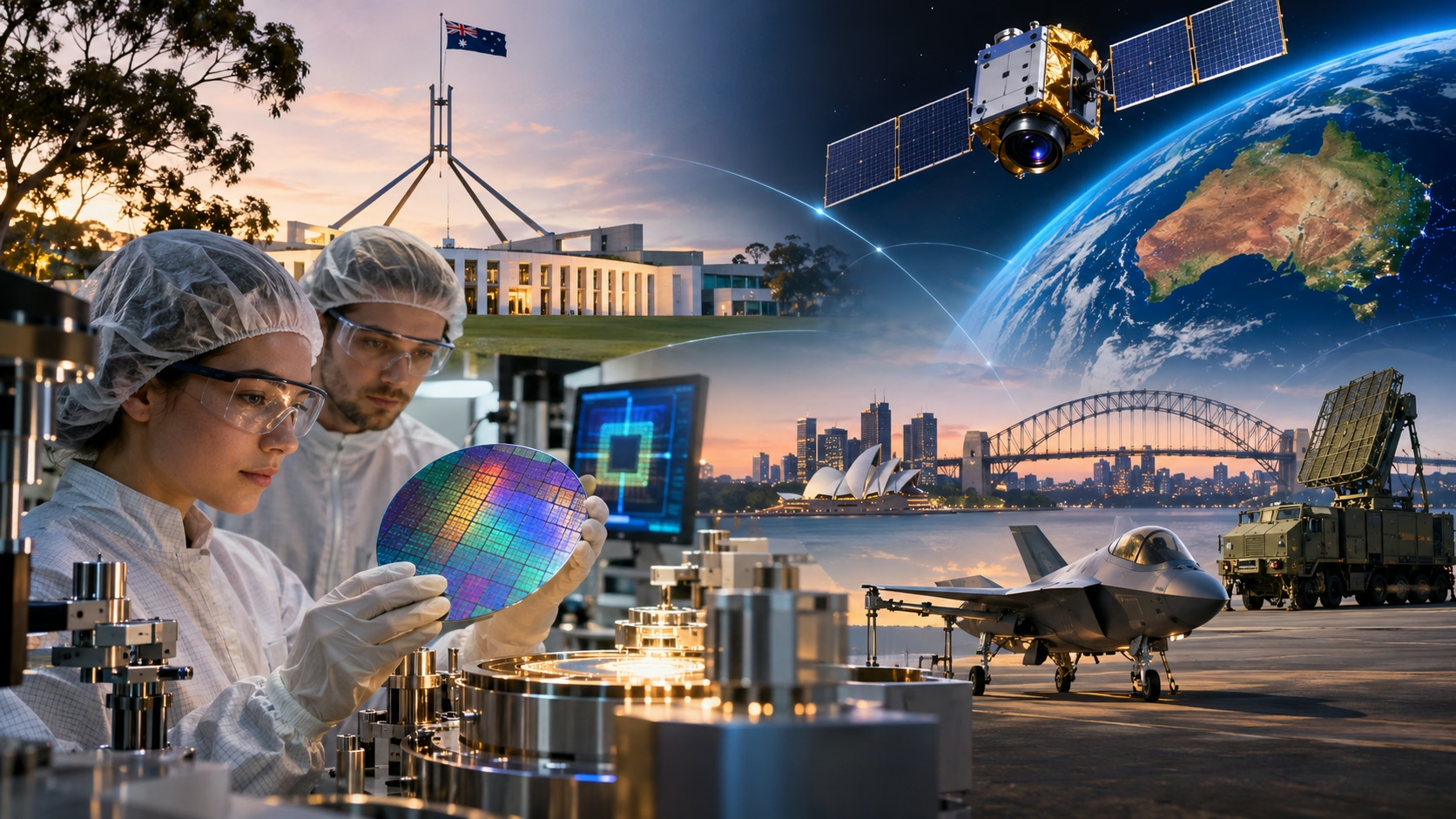
The Dual-Use Decade
Australia’s critical technology startup ecosystem is increasingly defined by dual-use innovation—technology that serves commercial markets and defence capability simultaneously. The 2026 Tech23 cohort, curated by Cicada Innovations, made the trend explicit: a record number of applicants, with five of the 23 selected companies working directly on sovereign capability and another ten operating in advanced manufacturing, AI, semiconductor hardware and defence to protect supply chains.
Cicada Innovations CEO Liza Noonan described the shift as founders increasingly building for national priority areas, with many innovations carrying dual-use potential that strengthens sovereign capabilities. That is a notable cultural change in the Australian startup scene, where defence-adjacent work was once treated with caution.
Autonomy, Resilience and the Tech23 Signal
The Tech23 cohort includes startups such as Forward Deployed, Dentroid, Armatide Pharmaceuticals and Arelis, which are tackling critical resilience, healthcare and defence technology. The cohort also features companies working on high-altitude airships, aerospace solutions and AI semiconductors—categories that sit directly within the “Critical Technology Quadrants” of space, quantum, AI and advanced materials that investors are now tracking.
The signal here is not simply that more startups are doing defence work. It is that the support infrastructure—incubators, investors, government programs—is beginning to treat dual-use deep tech as a legitimate and investable category. That normalisation is a precondition for scaling a defence industrial base that relies on private innovation rather than prime contractors alone.
The ACIF and the Procurement Pull-Through Problem
The Australian government’s proposed Advanced Capability Investment Fund (ACIF) is designed to catalyse private equity into defence capabilities, including AI, quantum and autonomy. But the ASPI analysis is blunt about the limitation: capital alone will not solve the problem. Australia has a strong research and startup ecosystem but a weaker record of moving technologies into volume production and sustained procurement.
The ACIF’s effectiveness will depend on procurement pull-through, clearer demand signals from Defence and credible pathways from prototype to contract. For AI and autonomy startups, the procurement challenge is especially acute because defence acquisition processes are often optimised for large platforms rather than iterating software and autonomous systems. The policy question is whether the fund can be paired with acquisition reform, not just capital injection.
AI Factories, Sovereign Infrastructure and the Compute Layer
The AI dimension of Australia’s strategic industry agenda extends beyond startups. In March 2026, the Australian government launched a National AI Plan, and Sharon AI and Cisco announced an AI factory in Australia to boost sovereign AI infrastructure. This matters for startups because access to compute is a binding constraint on AI commercialisation. Sovereign AI infrastructure reduces dependence on offshore cloud providers and creates a domestic layer for training, inference and data handling.
For dual-use AI startups, that infrastructure is strategically relevant in ways that go beyond cost. Defence and intelligence applications require data residency, supply-chain assurance and the ability to operate in disconnected or degraded environments. A domestic AI compute layer is therefore not just an economic development initiative; it is a national security input.
The Structural Shift: From Grants to Industrial Demand
The deeper trend in 2026 is that Australia’s critical technology startups are being pulled into a more structured relationship with the state. Grants and early-stage funding remain important, but the emerging model combines equity investment, procurement pathways and infrastructure provision. The risk is that dual-use rhetoric outpaces actual defence demand, and capital drifts toward commercially proven software and sensors rather than defence-unique capabilities. The opportunity is that Australia builds a genuinely integrated innovation-and-procurement system that turns startup agility into sustained strategic capability.