

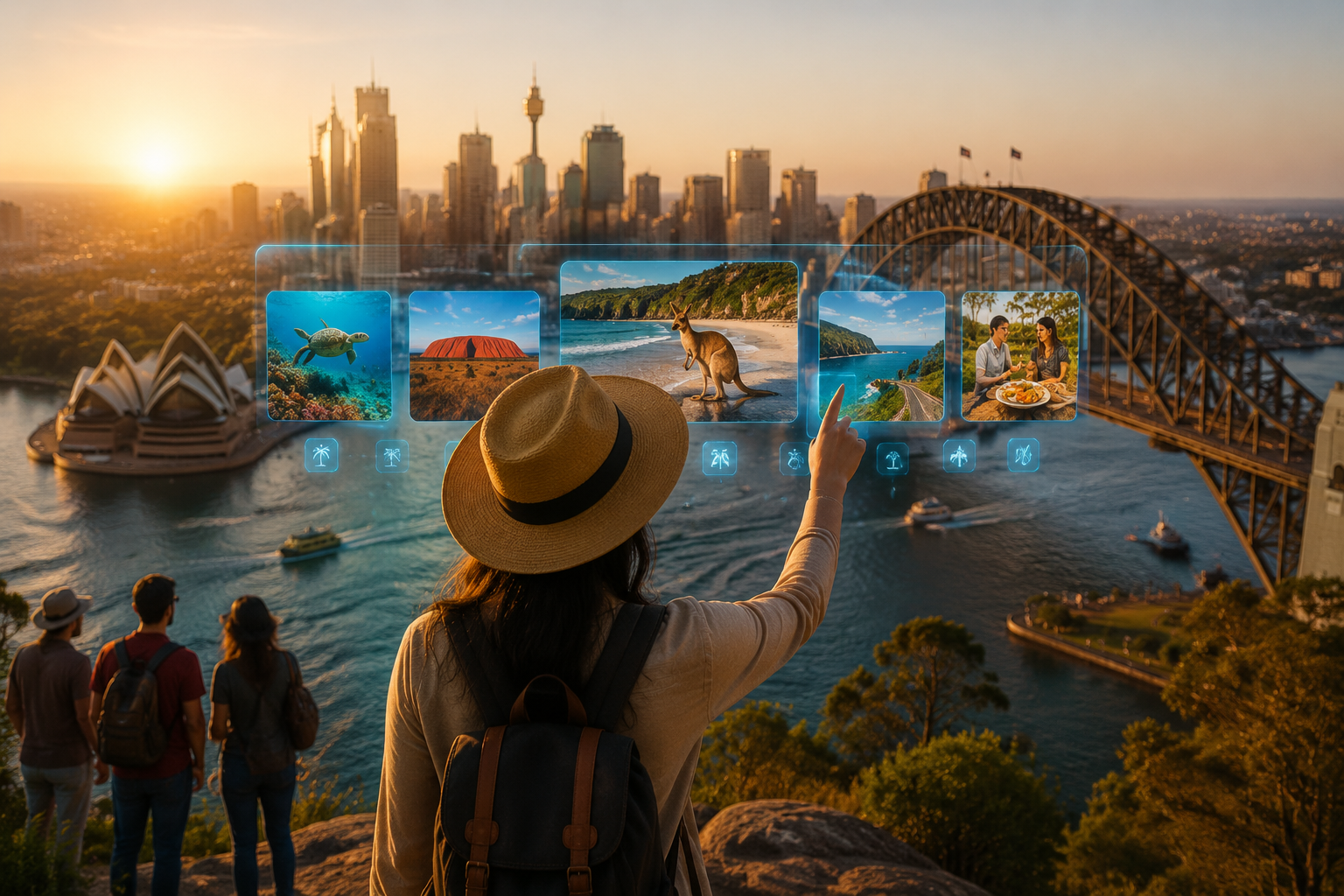
Beneath every inspiring Instagram shot of Whitehaven Beach is a sophisticated marketing infrastructure built on live data feeds, psychological triggers, and seamless booking technology. In 2026, the best‑performing Australian tourism companies are those that turn global attention into confirmed bookings in the shortest possible time, and they are doing it by making the customer’s decision path frictionless and socially validated.
Real‑Time Social Proof Engines
Operators like Flight Centre Travel Group have integrated live booking notifications and review feeds directly into their websites and app experiences. A prospective traveller in Canada researching the Great Ocean Road will see a subtle notification: “A family from Vancouver just booked a 7‑day self‑drive package 2 minutes ago.” This tactic, grounded in behavioural psychology, reduces hesitation and creates a healthy fear of missing out. Internally, Flight Centre reports that pages featuring live social proof convert at 23 percent above static counterparts.
Funnel Velocity and Predictive Retargeting
Advanced analytics platforms now segment international audiences not just by demographic, but by digital behaviour speed. “High‑velocity” users — those who visit three or more pages and check availability within a single session — are immediately retargeted with personalised, limited‑time incentive offers via programmatic advertising. If a user in Singapore abandons a snorkelling package in Cairns, they receive a dynamic ad featuring that exact product with a 10‑hour flash discount. This speed‑to‑lead approach has halved the typical long‑haul consideration window in key Southeast Asian markets.
TikTok and Vertical Video as Booking Catalysts
Australian state tourism organisations have reallocated major portions of their media budgets to short‑form vertical video platforms. However, the strategy is far more sophisticated than viral dancing. Destination NSW’s 2026 campaign uses TikTok’s “Instant Page” ad format, allowing viewers to book featured experiences without ever leaving the app. A user watching a 30‑second clip of a seaplane landing in Sydney Harbour can tap “Book Now” and complete a transaction in under 40 seconds, bridging inspiration and conversion instantly.
Seamless Multi‑Currency and Local Payment Integration
A critical barrier for global conversions is payment. Australian tourism e‑commerce platforms now automatically display packages in the user’s local currency and offer region‑specific payment methods such as Alipay, WeChat Pay, Klarna, and UPI. Behind the scenes, dynamic currency conversion partners are connected via APIs to deliver real‑time exchange rates. This removal of financial friction is cited by Tourism Australia’s digital performance updates as a primary driver of the surge in direct bookings from India and China through mid‑2026.
Attribution‑Led Budget Allocation
Gone are the days of measuring success by vanity metrics. Tourism operators employ multi‑touch attribution models that track a booking back through every digital touchpoint — a Pinterest pin, a Google Travel search, an email newsletter, a TikTok video. By applying this data, companies continuously shift spend towards the highest‑converting channels for each origin country, achieving marketing ROIs that are transparent and defensible to shareholders. Tourism Australia’s corporate strategy and performance reports highlight this data‑driven approach as key to their international marketing effectiveness in the current financial year.