

A Productivity Breakthrough or Another False Dawn?
Australia has spent the better part of a decade grappling with sluggish productivity growth, a challenge that economists have linked to weak business investment and an economy overly reliant on resources extraction. The AI infrastructure boom may be the catalyst that changes this trajectory.
According to the Commonwealth Bank of Australia, Australia has become the world’s third-largest AI investment destination, behind only the United States and China. This is a remarkable positioning for a nation of 27 million people, and it reflects the scale of the data centre pipeline that has emerged over the past 18 months.
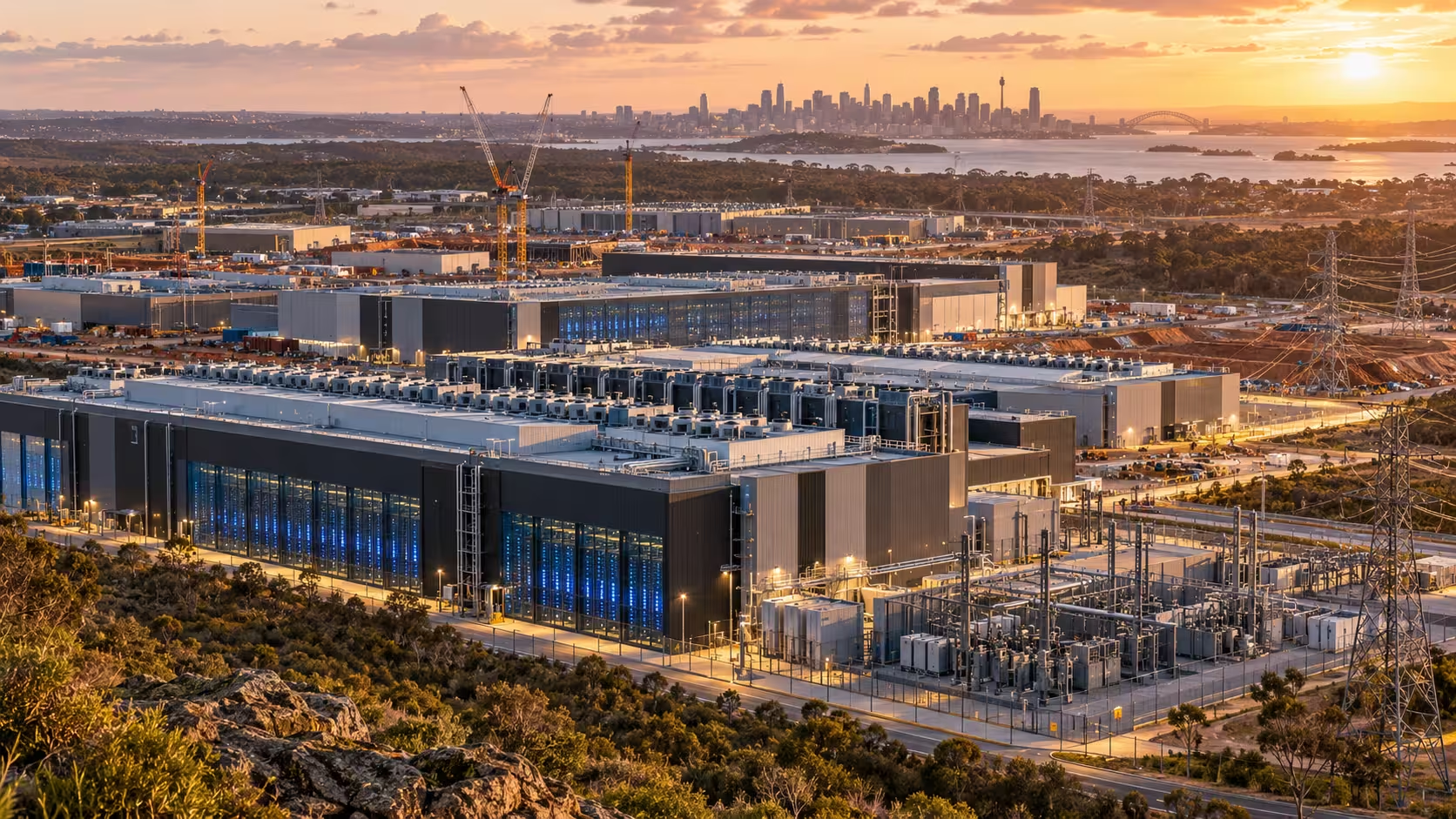
CBA’s updated estimates suggest the data centre pipeline is closer to 6 gigawatts or A$150 billion, implying installed capacity could more than triple over the period to 2030. The bank’s economists argue this investment cycle is set to spur productivity in an economy “currently struggling with a low potential growth rate and high inflation”.
The Investment Pulse Is Already Visible
The economic impact of the data centre build-out is not theoretical. Private capital expenditure in the information, media and telecommunications industry rose by almost 90 per cent in the first quarter of 2026, reaching nearly three times its level a year earlier. CommBank estimates data centres will add around six percentage points to real business investment growth in 2026 and around five percentage points in 2027.
To put this in context: Australia’s total real business investment growth in a typical year might be 3-5 per cent. Adding six percentage points from a single sector is an extraordinary concentration of investment activity. As CommBank economist Lucinda Jerogin noted, “It is a very significant addition to real business investment growth. And it’s going to be the dominant driver of business investment over the next few years”.
The GDP Contribution Is More Modest — And That’s Normal
Despite the scale of the business investment pulse, the direct contribution to GDP growth is expected to be more modest. CommBank estimates data centre investment will contribute around 0.2 percentage points to real GDP growth in both 2026 and 2027.
This gap between investment and GDP impact reflects the nature of data centre construction. A significant portion of the capital expenditure flows to imported equipment — servers, GPUs, networking gear — which is not captured in domestic GDP calculations. The domestic value-add comes from construction, electrical work, and professional services, which represent a smaller share of total project costs.
The Long-Term Productivity Opportunity
The more significant economic impact may come over the longer term, as AI adoption spreads through the economy. PwC’s Global Data Centre Outlook projects Australia will attract approximately US$703 billion in cumulative AI infrastructure investment by 2050**, with annual capital expenditure rising from **US$16.5 billion in 2026 to US$41.6 billion by 2050.
Crucially, PwC notes that AI infrastructure is different from traditional infrastructure in one important respect: spending continues to rise over time. Unlike a road or a bridge, which requires minimal ongoing investment once built, AI infrastructure requires regular upgrades and replacements. ICT equipment is forecast to account for an increasing share of investment, lifting globally from around 70 per cent today to 93 per cent by 2050. In Australia, annual investment in ICT equipment is projected to reach US$38.2 billion by 2050**, compared with **US$3.3 billion for construction.
The Productivity Payoff
The ultimate economic prize is productivity. If Australian businesses can leverage AI infrastructure to automate processes, improve decision-making, and develop new products and services, the productivity gains could be transformative. PwC Global Infrastructure Leader Clara Cutajar described AI infrastructure as “one of the defining capital allocation challenges of the next generation,” cutting across technology, energy, real estate, supply chains, regulation and financing.
For investors, the productivity narrative matters because it underpins the sustainability of the investment cycle. If AI adoption generates measurable productivity gains, demand for data centre capacity will continue to grow. If it does not, the pipeline of announced projects may face downward revisions. The next two to three years will be critical in determining which scenario unfolds.